



FTCO
Fab Technology Co-Optimization (FTCO™)
What is FTCO?
Engineering intelligence, not just engineering data
Engineering intelligence tailored to your problem
Explore, optimize, and decide in real time
FTCO Solutions, from your simulations to
engineering intelligence at scale
Accelerate simulation workflows and create engineering-ready surrogate models
01
Define the engineering space
02
Generate engineering data
Have Victory DoE automatically execute the simulation campaign and collect the resulting data. Existing measurement data can also be incorporated where available. Physics-based simulation provides the foundation for the engineering intelligence that follows.
03
Build engineering intelligence
Victory Analytics applies analytics and machine learning to the collected data, revealing relationships, sensitivities, dependencies, and trade-offs within the engineering problem. The resulting engineering intelligence is tailored to the technology, objectives, and workflow being addressed.
04
Accelerate engineering workflows
Apply engineering intelligence to traditional workflows such as calibration, analysis, sensitivity studies, process capability evaluation, optimization, and multi-response trade-off exploration.
05
Create surrogate models
Use the engineering intelligence to build machine-learned surrogate models that make simulation-derived knowledge accessible in real time. Depending on the application, surrogate models can represent structures, complete response curves, or engineering metrics, enabling rapid exploration of design and process scenarios.
Scaling Calibration Expertise
Calibration remains essential for predictive simulation. FTCO accelerates calibration
workflows, helping organizations apply expert knowledge more efficiently and address growing
engineering complexity with limited specialist resources.
Accelerating calibration workflows
FTCO accelerates calibration workflows through automation, analytics, and machine learning. By helping engineers identify the most influential parameters, quantify sensitivities, and focus effort where it matters most, FTCO can significantly reduce the time required to achieve calibrated simulation models while scaling expertise across engineering teams.
From calibrated simulation to engineering intelligence
What you need to bring
From Simulated Points to Real-Time
Engineering Intelligence
Traditional simulations provide answers only for the conditions that were run. FTCO surrogate
models learn the relationships between those results, enabling engineers to predict outcomes,
explore trade-offs, and evaluate scenarios that were never explicitly simulated.
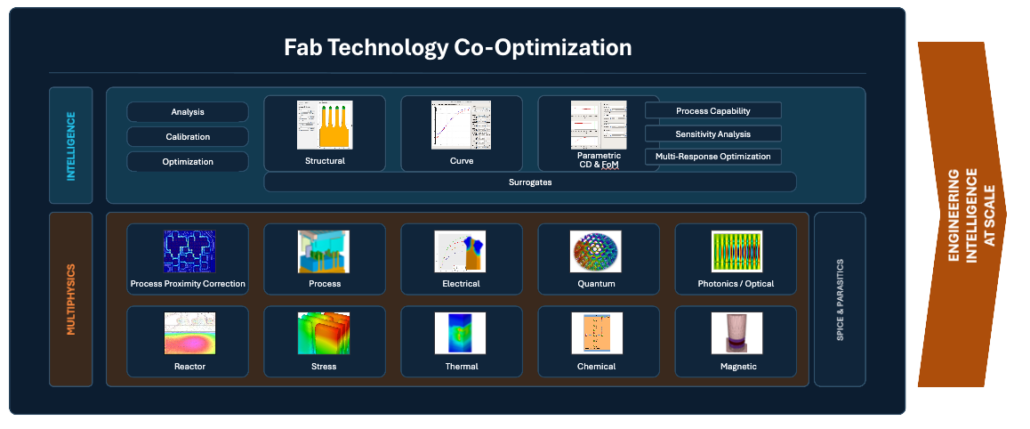
Three different types of surrogates are available – structural, curve, parametric – which support
different engineering tasks, from interactive structure exploration to process and IV optimization
and capability analysis.”
Understand Process Sensitivities
Parametric Surrogate
Identify which process, design, or operating parameters have the greatest impact on the metrics you care about. Parametric surrogates enable rapid sensitivity studies without launching new simulation campaigns.
Which process parameter has the largest impact on threshold voltage?
The surrogate ranks parameter influence and highlights the most sensitive variables.
Evaluate Process Capability
Parametric Surrogate
Assess the impact of manufacturing variation on device and process performance. Parametric surrogates support capability analysis and statistical studies across large parameter populations.
What happens if oxide thickness varies lot to lot?
The surrogate predicts the resulting spread in device and process metrics.
Optimize Multiple Objectives
Parametric Surrogate
Explore trade-offs between competing engineering targets and identify parameter combinations that satisfy multiple constraints simultaneously. Parametric surrogates enable rapid multi-response optimization studies.
Can I improve drive current without exceeding leakage limits?
The surrogate identifies process settings that best satisfy both objectives.
Explore Structure Changes
Structure Surrogate
Interactively visualize how process variations affect geometry and physical structures. Engineers can explore structural changes in real time rather than rerunning full simulation flows.
How does increasing etch time change the profile?
The surrogate instantly predicts the resulting structure geometry.
Predict Complete Device Behavior
Curve Surrogate
Evaluate entire response curves across operating conditions. Curve surrogates predict full device or process responses instead of individual metrics.
How does a process change affect the IV curve?
The surrogate predicts the complete IV response without running a new simulation.
The tools behind FTCO
Add intelligence to multiphysics
Victory Analytics
Provides the machine learning capabilities.
Victory DoE
Designs the experiments and keeps every simulation project's results in one place, ready for Victory Analytics.
Multiphysics Tools
Build the multiphyiscs flow that suits your needs
Built with Micron Technology for memory devices
FTCO took shape through a collaboration with Micron Technology, Inc., around the process questions memory development raises.
Memory | Digital twin
April 2024
Micron Technology
Micron’s engineers use an FTCO digital twin to speed design and pathfinding on memory products. The twin learns from Micron’s production data and from physics-based simulation of etching, deposition and mechanical stress. Engineers outside the TCAD team get process, design and yield optimization in their own hands.
“Silvaco’s AI and digital twin solution is enabling us to accelerate our groundbreaking advancements in memory and storage.”
Dr. Gurtej Sandhu, Principal Fellow of Technology Pathfinding, Micron Technology, Inc.

FTCO resources
Conference talks and webinars on fab technology co-optimization, plus a SEMI interview on where it came from.
Webinar
Manufacturing-Aware PIC Simulation Webinar FTCO & Digital Twins
Modern semiconductor development requires rapid exploration of large design spaces while maintaining the predictive accuracy of physics-based simulation.

Webinar
TCAD-Aware SPICE Model Extraction with Utmost IV: From Manufacturing to Surrogate Circuit Modeling
Accurate compact models are essential for translating device behavior into trustworthy circuit simulation,
Webinar
Accelerating Manufacturing-Aware Simulations for Photonic Integrated Circuits with FTCO™ and Digital Twins
Photonic integrated circuit (PIC) designers face a persistent challenge: devices that perform well in simulation often underperform after fabrication.
Conference talk
SURGE 2025
How to Utilize Victory Analytics and Machine Learning to Calibrate TCAD Data
Dr. Stefania Carapezzi, Field Applications Engineer at Silvaco, on calibrating TCAD data with machine learning in Victory Analytics.
Conference talk
SURGE 2025
AI Takes EDA to the Next Level
Dr. Walden (Wally) Rhines, now Silvaco's CEO, on where AI is taking electronic design automation.
Webinar · SEMI
Developing Silicon Carbide DMOSFETs: A Digital Twin Design Reference Flow
A SEMI-hosted webinar on silicon carbide DMOSFET development.
Webinar
Applying Artificial Intelligence in Fab Technology Co-Optimization (FTCO™)
Silvaco's webinar on putting AI to work in fab technology co-optimization.
Interview · SEMI
Applying AI in fab technology co-optimization
SEMI talks to former Silvaco CEO Dr. Babak Taheri about FTCO.
Presentation · PDF
SURGE 2025
FTCO overview
The whole FTCO workflow in one document.
Talk to an FTCO expert
Tell us which process you want a digital twin of and what data you already have on it.
Measurements from split conditions and the parameters you’re trading off are a good place to start.
An FTCO expert will get back to you on what it takes for your process.
Questions about FTCO
What is FTCO?
FTCO stands for Fab Technology Co-Optimization. It is an intelligence solution platform that combines multiphysics simulation, automation, analytics, and machine learning to create engineering intelligence. Depending on the application, that intelligence can support calibration, optimization, sensitivity analysis, process capability studies, and surrogate model development.
What is a surrogate model?
A surrogate model is a machine-learned representation of engineering behavior built from simulation and, where available, manufacturing data. Unlike a collection of simulation results, a surrogate model learns the relationships between those results, enabling engineers to predict outcomes, explore trade-offs, and evaluate conditions that were not explicitly simulated in the original DOE campaign. It can represent structures, response curves, or engineering metrics depending on the application.
How is a surrogate model built, and how accurate is it?
By employing an FTCO surrogate workflow. Victory DoE uses a user-defined multiphysics simulation flow to generate simulation data across a defined engineering space. Victory Analytics then applies machine learning to learn the relationships between those simulation results and create a surrogate model. Unlike a DOE result table, the surrogate model can evaluate additional conditions and parameter combinations beyond the original simulation set. Accuracy depends on the quality of the simulations, coverage of the engineering space, and, where applicable, calibration against measured data.
How is a surrogate calibrated against real silicon?
Calibration occurs at the simulation level. Engineers compare multiphysics simulation results with measured manufacturing data and refine the simulation until it accurately represents process behavior. An FTCO calibration workflow can be used to significantly accelerate the calibration step through automation, analytics, and machine learning. The calibrated simulations then become the foundation for engineering intelligence and surrogate models.